
Down Syndrome and Parenting: The Cold Current of Doubt
Posted: August 22, 2014 Filed under: advocacy, disability, Down syndrome, parenting | Tags: Ableism, disability, Down syndrome, Parenting, Special Needs 24 CommentsLP did his first sign many, many months ago. “More.” Sometime soon after that, he started using a fork independently. The kid loves eating, so no surprise there. Life was much, much easier being able to sit LP down with a plate of cut up food and a fork. Very civilized, right? He was starting to use a spoon as well. Good.
Then it stopped. Forks got hurled across the room. No signing. Just smeared food and yelling. A lot of yelling. For weeks. And weeks. I can’t lie—it sucked. We’d sign and sometimes it seemed like he understood, and sometimes he just looked at us like we were aliens. Mealtimes became a nightmare of throwing, cajoling and yelling. I’d wonder, was I babying him? Was I insisting on too much? The way he’d moan and whine, it really seemed like he was suddenly incapable of communicating or self-feeding.
Around this time, he really started getting confident with his standing. He was cruising around furniture with a lot of ease and standing on his own for many seconds at a time. One day, Mouse taught him to use a little tricycle as a walker. Great! So I figured, he’s working on the walking, just be patient.
I was patient, or so I thought. But the days turned into weeks, and I started to wonder. Is something wrong? How could a skill have just disappeared like that? Was it his thyroid (we have been trying to adjust his dosage and that is a whole ‘nother post)? Maybe this was a sign of something else, for a skill to have just vanished? Was there another diagnosis in his future? Why wouldn’t he just go back to doing it??? I admit during these moments, I’d try to size LP up among his peers with T21. Each time I was a kid who was around his age doing something that he didn’t do, I’d feel a pang of anxiety. Was he ok?
It is hard sometimes when it feels like the world is telling you that your kid is more wrong than right, not to let some of it seep in. In the media, most of what I see are awful stereotypes and misinformation, or hideous debates about prenatal testing and abortion. The positive is largely sickly sweet stuff that leaves me feeling more sad than anything else.
As much as our friends and family have been supportive, it isn’t a walk in the park there, either. I can’t shake that raw feeling when it seems like the only questions I get asked about LP are about his development. Does he walk, talk, do this, do that? I feel a real twinge of pain when someone goes out of their way to praise the girls only, because the next thought I have is, What about LP?
I don’t know how fair it is for me to feel this way. There’s nothing wrong with the girls being talented in some way that their brother isn’t. By and large, when people discuss babies, it is about development, Down syndrome or not. For the most part, people truly care about LP, and I imagine it is easy to get caught up in trying to figure out what the “right” or “wrong” thing to say is.
Yet, I can’t help but notice that the tenor surrounding LP is different. There’s so little faith in him.
It isn’t about an inevitable when for him, it is a big if. I’m guilty of it too—without constant change to reassure me, it is all too easy to let myself slip into a strange place in my mind in which he might never hold a fork again until he is five years old. Despite that I know this thinking makes no sense, I have to fight it back; that cold doubt still tries to seep through. People are shocked to see that he is a social, developing kid, delays and all. I’ve had people be very honest with me about this disconnect between what they expect and what really is. When they see him begging for grapes or giggling with his sisters, it strikes people that he is so very “normal” after all, i.e. not the vague blob of sadness that they’d imagined. I have to admit then, that I imagined the same vague blob when we first realized LP had T21. How wrong I was.
This week, LP started signing again. In fact, he is now sometimes stringing two signs together. He’s imitating words. He even used a fork twice yesterday during lunch. (We will therefore forgive him for throwing said fork after the second usage.) I’m the first to admit that I heaved a sigh of relief. And then some guilt for having doubted him at all.
What is the effect of having a world around you, even your own parent, that doubts your future on such a fundamental level?
I am reminded nearly every day that Down syndrome is supposedly a very bad thing. No one has used the word “retard” around me in quite some time, but I’m still witness to the same jokes, simply with the word omitted, in which lack of intelligence or ability becomes the pinnacle of hilarity. I still hear comments at the park about the dangers of having babies too late, with “old eggs”, knowing that the one very feared outcome is a child like my son. I am still squeezed under the constant pressure to raise my kids to be achieve, be smart, above all else, it seems. Because, unless LP grows up to be independent and have a job, he will be nothing but a drain on the rest of us, apparently (yes, sarcasm there).
All of that seeps into my unconsciousness, whether I like it or not, it seems. It is a crappy place to be, needing to be your child’s soft place to land, yet finding yourself dragged under by a black current of doubt. It feels like I’m constantly swimming against the tide, saying, He’s enough just as he is, I want him just as he is, over and over again, in different ways, yet feeling like my words get washed away in that cold, ableist current. It isn’t hard to let my mind wander, lose my compass and doubt more than I believe.
One of the worst things about being marginalized in any way is that eventually, some of it starts to blend into our identities. I don’t want that. I don’t want LP to be mostly about what isn’t, what can’t be, what might not.
Right now, he’s doing exactly what he is supposed to be doing, and I’m trying hard not to forget that fact.
Passing the torch
Posted: August 5, 2014 Filed under: Dear Chipmunk, Dear LP, kids, parenting | Tags: growing up, middle child, Parenting 11 CommentsDear Chipmunk and LP,
Congratulations! Chipmunk, you have officially passed the Trouble Torch to your little brother. What is the Trouble Torch? Why, it is the torch carried by the child who is most often in trouble.
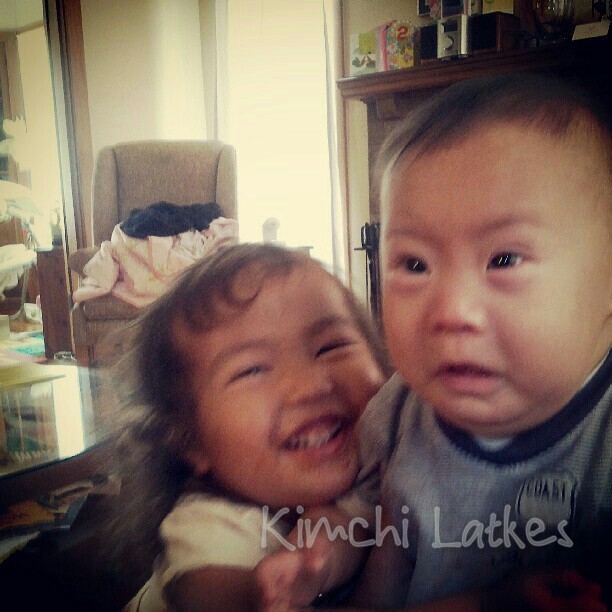
You carried it faithfully for over two years, Chipmunk. From the time you started walking and talking, you’ve been a small yelling machine. After being such an easy going baby, I have to hand it to you, that was a good trick you played and me and your father.
Speaking of your father, I blame him for your prolonged torch carrying. He’s quick to anger and quick to forgive; you seem to take after him. (I think later, that characteristic will be endearing. Not right now though, sorry.) I admit that it gives me secret chuckles to watch you guys get under each others’ skin. Then again, I’m pretty sure he laughs just as hard when Mouse and I have week-long, silent standoffs.
LP, it looks like you are going to be a very diligent Trouble Torch bearer. Every morning you wake at sunrise and devote every single waking moment to something I’d rather you didn’t do.

Trouble, I'm telling you.
My favorite is when you acquire small objects to drop into the heater intake. A lot of people think it is funny, that you couldn’t possibly know that it is wrong. I beg to differ, because when I spot you getting my driver’s license out of my wallet, it seems mightily suspicious that you high tail it to the heater grate with a maniacal laugh.

I threw my fork, demanded it back, and she actually got it for me. The injustice...
Let’s not forget the rearranging of anything and everything in a drawer, hurling food and utensils just for fun, or learning how to undo the baby gate before you learn to walk. Then there is the dying chicken squawk-cry that you have when you don’t get your way. That doesn’t get on my nerves at all.
I guess you’re both growing up. Chipmunk, you are turning into a little girl. LP, you are really getting the hang of toddlerhood. You’ve had a pretty hilarious relationship so far. I can’t say that LP has really appreciated you in the past, Chipmunk, but I think that is changing. 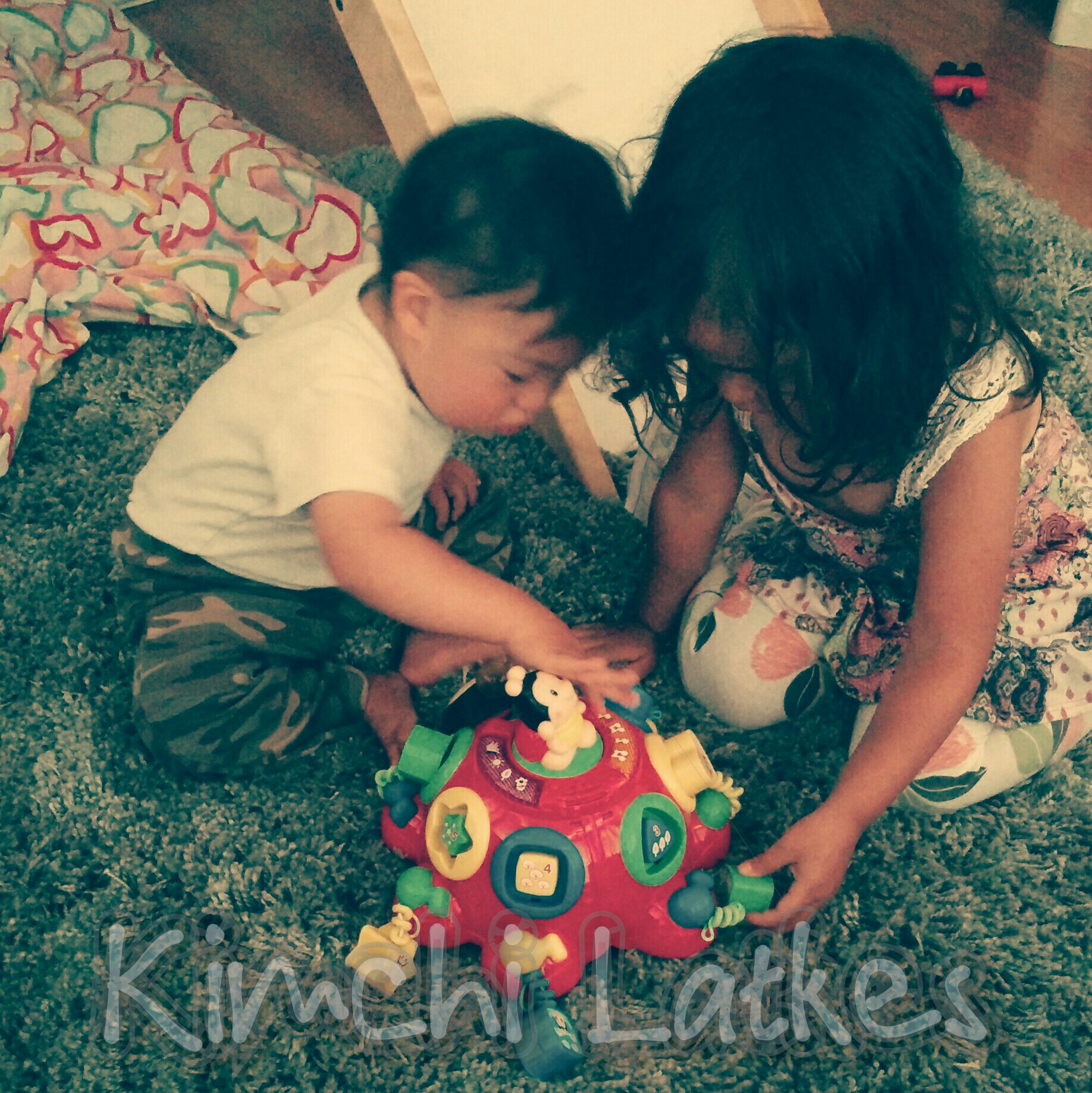
Aside from driving me to my wit’s end, you guys are doing pretty well. You should stick together, you’ll be the middle children, after all.
Love,
Your tired mother
Monday Musings: Standing In The Gap
Posted: February 17, 2014 Filed under: advocacy, being Korean, disability, emotional stuff, parenting | Tags: disability, immigration, Parenting, perspective, race, religion, values 23 CommentsNo, not the giant clothing label. I mean, the gap, that place in between where I seem to constantly find myself.
Recently I was in a conversation about bridging divides, and someone told me that my purpose in life might be to stand in the gap. I find myself often feeling so sympathetic to two seemingly opposite points of view, and I wonder, am I being inclusive or being too relativist? I’ve chewed that over for a few days.

Here’s my feet. Standing. Between two lines.
I do feel like I’m forever in a gap. I’ve felt this way ever since I can remember. Growing up as an immigrant, I never felt at home like others seemed to feel. I was eternally confused in my friends’ houses. Why are there so many darn table utensils? Why are their beds so complicated and ruffly? Why do they all wear their shoes on the carpet? Why is breakfast always sweet bready stuff? I can’t say that being in Korea felt like home either, though. My Korean is about as good as a first or second grader’s (and maybe that is a stretch). I have a distinct memory of my cousin teasing me about how dark my skin was (from so many hours of running around in the California sun). Most of all, I couldn’t quite feel comfortable in a place that was so… homogeneous. The San Francisco Bay Area is so diverse, I’d gotten used to seeing every color under the rainbow, every style, every language, all on the streets together. As a result of all this, I never felt like I totally “got” my family, but never felt like my friends “got” me either.
After my sister died, I felt caught between childhood and adulthood. At eleven years old, I’d found my baby sister cold dead in her crib. Hours after the ambulance had taken her away, someone took me to the hospital. I don’t remember walking into the building, or who even brought me. I will forever remember walking up to my mom, holding my sister’s body. My mother said, “She just looks asleep.” Aside from the marks left on her face from the intubation, she did look asleep, and I immediately understood why my mother couldn’t give her body up. It seemed unfathomable that the spark of life could leave a body like that, forever. I grew up a lot that year. That kind of finality, and the resulting wild grief that my parents endured was a lot for an eleven year old. I felt half like the young child that I was, and half like I’d already lived too much.
I’ve grown up between privilege as well. After some pretty working class beginnings, by elementary school I was attending an overwhelmingly white school district that was very wealthy. We, however, were neither white nor wealthy. I very much felt my model minority status. I can’t tell you how many times teachers made comments about “my background” being the reason I did well in school. I assure you, those teachers did not mean my mom and dad’s parenting skills.
Yet, I didn’t feel like I necessarily came from the “wrong side of the tracks” either. This has persisted as I’ve become an adult; I see a lot of wealth and privilege around me, and honestly, I’m never sure if I’m part of it or not. We live in East Oakland, on the edge of what seems like one of the last working class neighborhoods in the entire Bay Area. I can’t deny that there is gang activity and lots of poverty very close to our house. I’m not white, but most of my friends are. We are not experiencing poverty by any means, but we struggle some months. Heck, my husband is a lawyer, and I’m a stay-at-home-mom. We have the choice to eat organic food most of the time. That feels like privilege. Yet, I feel outside of the groups that are considered the most privileged in this country. I’m a brown-skinned immigrant, after all, and I’ve felt the real negative consequences of being made into the Other.
Then… God. After I left Catholicism, I drifted. For a while I thought I was agnostic, but over the years, I haven’t been able to truthfully deny that I do believe. Just like I hear atheist friends say that in their core, they know there’s nothing out there, I feel in my core that there is something out there. No, not men with beards in fluffy clouds. Or even one single divine omniscient being. All I know is that there’s something there. Organized religion, however, all falls apart for me. I just can’t do the dogma, the structure, the rules. Yet, I find myself defending religion all the time. When I listen to people speak about faith and God, it does speak to me. The language might differ, but important messages all sound the same to me whether they come from a place of belief or not.
More recently, I’ve found myself in a gap of Disability Land. I have a hard time even navigating the language I use on a daily basis. I’m a parent of a disabled child. I’m a parent of a child with a disability. I’m a parent. My child has 47 chromosomes. He’s my son. I’m his parent. Words matter, and I struggle in this Disability Land gap. I’ll forever be connected to his disability but will never experience it myself. I am constantly walking the tightrope of my own feelings and respecting his future.
Sometimes, I find standing in the gap lonely. Other people look so confident and secure in their willingness to pick sides, speak so unequivocally, and I wonder if there is something wrong with me that I seem unable to do the same. Other times it is freeing. I get to swim in my current and not anyone else’s. Finally, in my thirties, I’ve discovered that even though it takes more energy for me to be this way, it is better for my heart and soul to do my own thing.
All my life, I’ve had people try to push me one way or another, to pick a camp between Right and Wrong, Should and Shouldn’t, Good and Bad. I worry that others think I’ve got no moral compass, but the fact is that I find it more fruitful to study that gap, stand in the gap, explore why the gap exists, than to pick a side and try to pull anyone else over. Maybe that friend was right. I guess this is where I’m meant to be. Maybe if I stand here long enough, the gap won’t seem like such a gap, just another place to be. Then, we can all stand together.


 Kimchi Latkes