
#WDSD14: Introducing the Down Syndrome Diagnosis Network!
Posted: March 21, 2014 Filed under: advocacy, disability, Down syndrome | Tags: birth, disability, Down syndrome, early childhood, Prenatal Testing, Trisomy21, World Down Syndrome Day 8 Comments Empowerment. Agency. Community.
These are words that most parents would not associate with learning that their child has a disability. Yet, those are three words I would use to describe my story.
My third child—we call him the Little Pirate—has Down syndrome. We didn’t get our diagnosis until he was almost three months old.
Our story began during pregnancy. Our homebirth midwife not only respected, but truly understood our choice to forgo prenatal testing. She had a sense of our family’s personality. She asked about our values and beliefs. I don’t believe that abortion should become illegal, yet I didn’t want one myself. For us, the information alone would not outweigh the accompanying worry and uncertainty. Prenatal testing is a complicated calculus and she helped us navigate it with no assumptions, no judgments.
Ultimately, we had an uncomplicated pregnancy and birth. The Little Pirate did not have many of the characteristics associated with the syndrome, and so no one suspected a thing. Things got more difficult after a few weeks, when our son opened his eyes and suddenly, the words Down syndrome rolled like ticker tape across my consciousness.
After just a few days, I already knew in the primal way only a mother can know—my baby had Down syndrome. I remember very clearly, sitting on our couch during a two-hour impromptu visit from our midwife, crying. We would have to submit to a genetic karyotype to confirm that he had Down syndrome. It felt like standing on an open prairie, watching a storm brewing on the horizon, powerless to stop the future from tearing us apart.
Then, our midwife told us that we could decline the karyotype test. There was no immediate medical need; we could wait. This was a revelation to me.
I hear all too often that diagnostic screening and testing are foisted upon patients as a matter of course. In my online support group, I was horrified to learn that many doctors never bother to explain the difference between a prenatal screening and a diagnostic test, let alone why a family would choose to undergo such procedures. Many families who have had birth diagnoses have told me that they were simply told that the doctors suspected Down syndrome, and test results would be ready in a few days. I can’t think of a more powerless way to receive such important news. Diagnoses are sometimes delivered as if a terrible tragedy has befallen a family, causing unnecessary pain.
We ultimately did get an official diagnosis, mainly in order to rule out certain medical issues common in babies with Down syndrome. By then, my husband and I had already begun to accept what a Down syndrome diagnosis could mean. We had the support and information we needed in order to peek down both paths, and understood that our family could be happy with either direction our lives took. It was with that sense of empowerment and agency that we chose to take our infant son to our local children’s hospital and find out, once and for all, how many chromosomes he had.
He had 47 chromosomes. We stood on the open prairie; the storm was coming.
Those early weeks were certainly not carefree. I had a flurry of obsessive research that prematurely aged me. I worried about health issues. I had to examine some very ugly beliefs I had about disability, and that personal growth did not come easy.
Still, the storm that was our son’s diagnosis was the prelude to a period of lush growth in our family. My husband and I stood together, our eyes open. There were some beliefs and assumptions we held that needed to be destroyed. The storm passed and our family was nourished in ways we never could have predicted.
We had weathered the storm on purpose, struggled out into the open, and tasted a deep acceptance that caused us to re-examine what truly mattered in life. Love. Inclusion. Respect.
I believe that with truly family-centered care and real-life support, my experience shouldn’t be unique to those who have made the same choices as we did. Families who find out that their children have Down syndrome prenatally, at birth, or after could experience the same level of empowerment.
I want change. I want to give families a chance for a better story.
The Down Syndrome Diagnosis Network (DSDN) will officially launch on March 21st, World Down Syndrome Day. DSDN is a group of eight mothers who believe that our stories can change. Through our medical feedback program, online community, resources, and local support referrals, a better story can emerge for families with a Down syndrome diagnosis.
Join us.

Visit our website
www.facebook.com/DownSyndromeDiagnosisNetwork
Twitter: @TheDSDN
Instagram: thedsdn
World Down Syndrome Day Countdown: A Day in the Life
Posted: March 19, 2014 Filed under: advocacy, Down syndrome | Tags: disability, Down syndrome, Family, Parenting 20 CommentsMarch 21st is World Down Syndrome Day. My kid who has Down syndrome is 16 months old.
Our day starts off something like this:
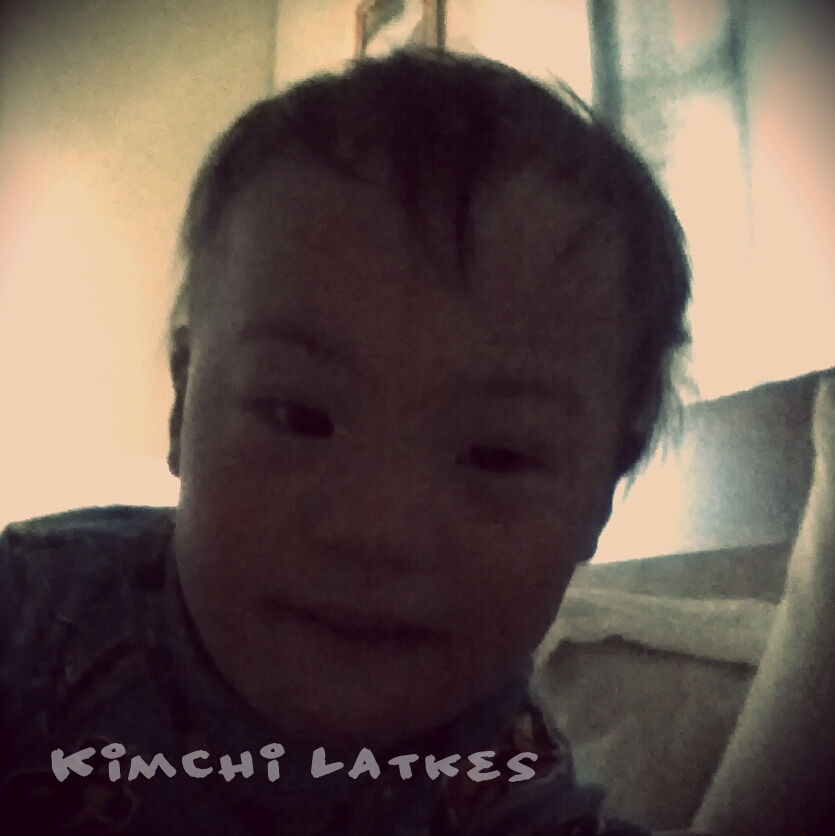
Not a bad way to wake up in the morning, eh?
LP sits up in bed. I let him into our bed around 4:30 or 5 each morning, hoping that I’ll get more sleep. “Sleep” in this particular instance is defined as nursing while kicking me and then rolling over all over the bed using me and his dad as human pillows for a couple of hours. His two morning activities are usually a) picking my nose and b) pulling open my shirt to ask for more milk.
Somewhere in there, he usually does his funny grunting noise which signals that he needs to poop. I put him on the potty while he stares at his junk as if it the best thing EVER.
Downstairs I make breakfast while Mouse and Chipmunk resume some kind of mind-achingly complicated make-believe game. LP usually makes a beeline to the dog and methodically tortures plays with him. I always find this hilarious, because our dog could just sit on LP and crush him, yet he actually seems to like it. I think those two are going to be best buds.
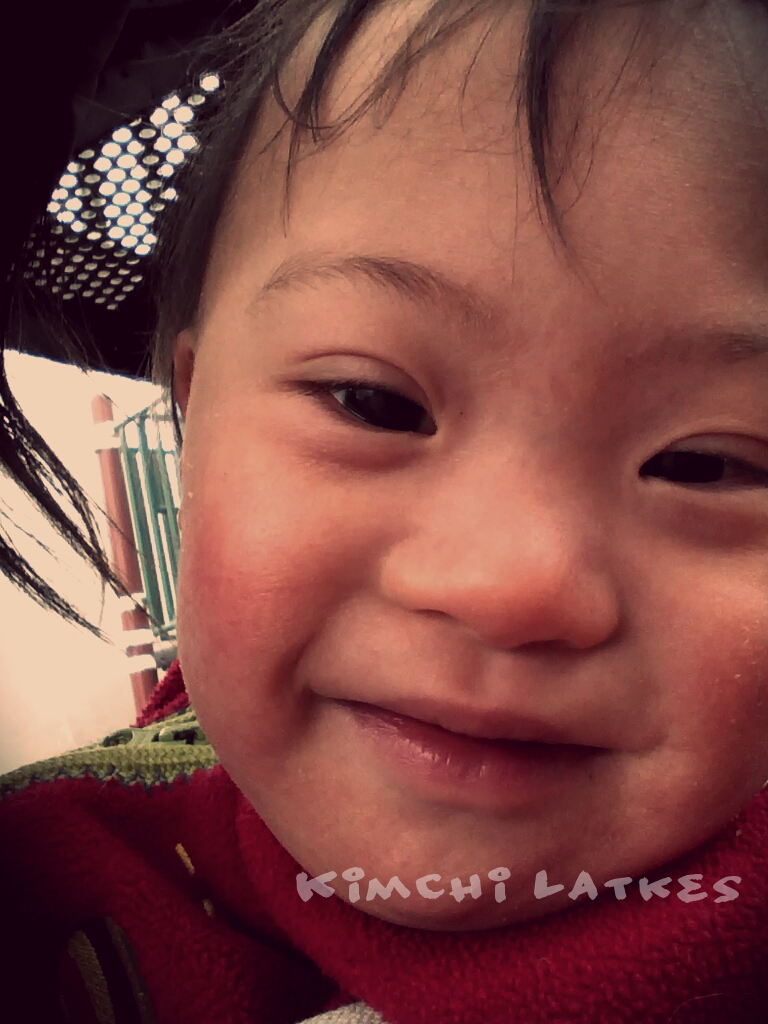
Peekaboo!
Yesterday, we dropped Mouse at art class, and Chipmunk, LP, Cisco (the dog) and I went for a walk. LP rides in a woven wrap on my back and usually narrates the walk. Lots of looking for Daddy and playing peekaboo with me from behind. Eats my hair. Cleans the wax out of my ears. Lately he’s been waving at strangers while he rides on my back, which makes me feel like a parade float.
After Mouse’s art class ended we met a friend for a play date. Some sand was eaten. Some swinging occurred. Somewhere in there, I fed the kids lunch.
Home. General mayhem while I make dinner. Daddy comes home, more mayhem.
Bedtime. Blessedly quiet bedtime.
Now I must also mention that the following things also occur nearly every day:
- LP yells approximately 493 times in frustration, joy, boredom, or happiness. Or, just to let me know that he can.
- The girls play “You’re the Worst” game at a minimum of ten times throughout the day. This game entails yelling “You’re the worst” back and forth, over and over again, until one sister screams in frustration and stomps off. Mommy usually wishes she could temporarily cut out her eardrums during this game.
- LP looks down my shirt, then nose dives towards my boob. This happens anywhere from three to twenty times during the day.
- When I go to the bathroom, something bad happens. The other day, I did this and Mouse started screaming. I ran out to the (gated) driveway where they were playing, and a little stray Maltese dog was rolling all over LP’s lap, scaring the bejeezus out of him. The girls pretty much thought this poor furball (who was actually a very sweet dog) was eating their brother, and much crying ensued. Today, while I was in the bathroom, Chipmunk peed her pants at the dining room table. Why? Because she couldn’t get down and wanted help, but then didn’t want help from Mouse. So it was the obvious that she should not just get down from her chair like she does EVERY DAMN DAY, but rather pee on it. I think this is why older women have incontinence, not childbirth or old age. We hold our pee because bad stuff happens when we are gone.
- Someone goes to the bathroom and there is no toilet paper.
- Someone does something inappropriate and gets hurt.
- Someone refuses to eat enough and then later demands unreasonable amounts of snack (request summarily denied in most cases).
- Someone has fun.
- Someone learns something new.
- Someone cries.

They love him more than me. Wah.
So, that’s a day in our life. Eat, play, sleep. Beautiful moments, all the way (even the ones that don’t seem so beautiful at the time).
Click HERE to join the blog hop!


 Kimchi Latkes